Can I Write Off a Camera? Section 179, Bonus and $2,500 Rule
Yes, usually in full this year. 2026 Section 179, bonus and de minimis rules for cameras, lenses and laptops, three worked examples, and the listed-property trap.

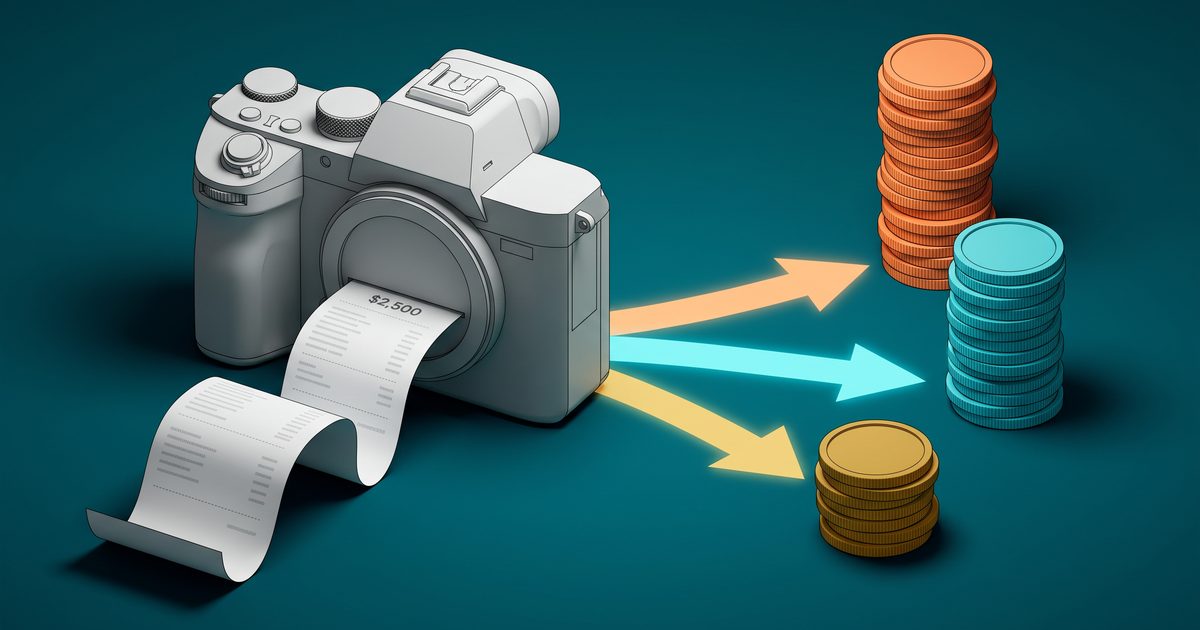
You bought a camera, a lens, or an editing laptop for your channel and want to know whether it comes off your taxes this year or drips out over several years. For most solo creators the answer is this year, in full, but there are three different routes to get there, and the route decides the paperwork, the limits, and what happens when you sell the gear. Below is one grid comparing the three with 2026 numbers, plus three worked purchases you can match to your own.
This is general information, not tax advice, and Paschal is not licensed to give it. The primary source is IRS Publication 946; confirm your own return with a tax professional. The rest of the creator tax guide, every form, tax and calculator in filing order, is at Creator Taxes.
I shot and edited my YouTube videos alone, in Final Cut, so the kit in these examples is the kit a one-person channel actually runs on: a body, glass, lights, and a machine to cut on.
The short answer
Yes, if the camera is used in a business rather than a hobby. If you’re not sure which side of that line your channel sits on, settle hobby vs business first, because the rest of this post assumes a business.
Three rules let you deduct gear faster than ordinary multi-year depreciation:
- De minimis safe harbor: expense any item or invoice up to $2,500 if you don’t have audited financial statements.
- Section 179: an election to expense the cost, capped at $2,560,000 for tax years beginning in 2026, with the cap reduced once qualifying purchases pass $4,090,000.
- Bonus depreciation (the “special depreciation allowance”): a permanent 100% for qualified property acquired after January 19, 2025, under the One, Big, Beautiful Bill Act.
The 2026 caps won’t touch a creator buying cameras. What matters is the per-item rule, the business-use tests, and the income limit. On a Schedule C, all three land as business expenses, so they reduce self-employment tax as well as income tax. Software, travel, the home studio, and the rest of the deduction list are in creator tax deductions; this post stays on gear.
Three ways to write off creator gear, side by side
Collected October 12, 2026 from IRS and California FTB pages; tax years noted in each cell.

| De minimis safe harbor | Section 179 | Bonus depreciation | |
|---|---|---|---|
| Typical gear | Lens, light, mic, monitor, drive at $2,500 or less each | Camera body, cinema rig, computer over $2,500 | Same as Section 179 |
| Limit | $2,500 per invoice or per item shown on the invoice | $2,560,000 for 2026, phased out above $4,090,000 | None; 100% of business-use cost |
| An item over the limit | Not eligible at all, not even partly | n/a | n/a |
| How you claim it | Statement titled “Section 1.263(a)-1(f) de minimis safe harbor election” on a timely filed original return | Elect on Form 4562 Part I, line 6 | Applies automatically on Form 4562 line 14 (line 25 for listed property) unless you elect out by class |
| Year of the deduction | Year you pay | Year placed in service | Year placed in service |
| Personal-use gear | No separate test in the rule; the personal share is never deductible | Needs more than 50% business use | Listed property (a camera with personal use) needs more than 50% |
| Income limit | None | Capped at taxable income from active trade or business, wages included; excess carries forward | None; can create a loss |
| Use drops to 50% or less later | Not covered by the Form 4797 use-drop rule, which is written for 179 and listed property; keep the item business-only | Recapture as income on Form 4797 | Recapture if listed property |
| Sell it later | Not a capital asset or Section 1231 property | Depreciation recapture as ordinary income | Same as Section 179 |
| California (2025 rules) | Check state treatment | State cap $25,000, threshold $200,000 | Listed as a federal/state difference |
Two rows in that grid do most of the work. The over-the-limit row kills de minimis for anything pricier than $2,500. The income-limit row is the only real difference between Section 179 and bonus for a federal-only filer.
Example 1: an $1,800 lens
Say a creator buys an $1,800 lens in March 2026 and uses it only for channel shoots. For a profitable channel, all three routes deduct $1,800 for 2026. The difference is paperwork.
De minimis is the clean pick. The lens is an expense on Schedule C, there’s no depreciation schedule, and Form 4562 isn’t needed: the Schedule C instructions require that form only for depreciation on property placed in service in the year, listed property, or a Section 179 deduction. You attach the election statement with your name, address, and taxpayer identification number. Without a written accounting policy, you still need a consistent practice in place at the start of the year of expensing items under the threshold.
Kits are where people slip. If the store invoice lists a body at $2,100 and a lens at $1,200 as separate lines, each item can be tested on its own, because the rule allows “per item as substantiated by the invoice”. A single bundle SKU at $3,300 is one item and fails. And asking a seller to split a unit into separate invoices just to fit under the cap is the exact move the anti-abuse rule names.
Example 2: a $3,500 camera body
De minimis is gone. The item is over $2,500, and the regulation’s own example treats an over-limit item as ineligible in full. You cannot expense $2,500 of it.
That leaves Section 179 or bonus. With a profitable channel and 100% business use, both deduct $3,500 for the year the body is placed in service. Bonus is what you get if you do nothing, since the special allowance applies unless you attach a statement electing out for that class of property. Section 179 is an active election in Part I.
Now make the channel young. Schedule C profit before the camera is $1,500, and there’s no other job.
- Section 179: line 11 caps the deduction at business income, so $1,500 comes off this year and $2,000 carries to 2027 on line 13.
- Bonus: the full $3,500 comes off, and Schedule C shows a $2,000 loss.
Neither is wrong. If a loss year would draw attention to a channel that already looks hobby-ish, take Section 179 and let the carryover wait. If the same creator also has a day job, note that the Form 4562 instructions count W-2 wages as business income for this limit, so $40,000 of salary clears the cap and Section 179 deducts the full $3,500.
The family-vacation problem: listed property
Most guides skip this. The Form 4562 instructions list “any property used for entertainment or recreational purposes,” such as photographic and video recording equipment, as listed property. The exception: equipment used exclusively in your trade or business, or at your regular business establishment, is not listed property. A home studio counts as that establishment only if it meets the home-office rules.

So a camera that never leaves the work bag is ordinary equipment. One that also shoots birthdays is listed property, and three things change:
- Section 179 and bonus both require more than 50% qualified business use.
- It goes in Part V of Form 4562, which asks whether you have evidence of business use and whether that evidence is written (lines 24a and 24b).
- If business use falls to 50% or less in a later year of the recovery period, part of the first-year deduction comes back as income on Form 4797.
Run the $3,500 body at 80% business use. The deductible base is $2,800 (80% of $3,500), and it can all come off in year one through line 25 or the Section 179 column of Part V. The other $700 is personal and never deductible. At 40% business use, there’s no Section 179 and no bonus; the $1,400 business share goes on line 27 and is depreciated over years.
If you can, keep one body that only does work. The 50% test, Part V, and the log all disappear.
Example 3: a laptop you also use personally
Computers are not on the listed-property list in the current Form 4562 instructions; the categories are passenger cars, other transport property, and entertainment or recreation property. That makes a mixed-use laptop simpler than a mixed-use camera.

Take a $2,800 laptop used 70% for editing and uploads, 30% for personal browsing. De minimis is out at $2,800. Section 179 works because business use is over 50%: multiply cost by the business percentage, the same method Publication 946 uses in its own example, for $1,960. Bonus also gives $1,960 on line 14. The remaining $840 is personal.
At 45% business use, Section 179 is off the table. Bonus is still available on the $1,260 business share, because the 50% bar for the special allowance applies to listed property, which this laptop isn’t. There’s a second reason to prefer bonus on a mixed-use laptop: Form 4797’s use-drop recapture covers Section 179 and listed property, and a laptop expensed with bonus is neither.
Software is a smaller version of the same question. Off-the-shelf computer software qualifies for Section 179 under Publication 946, so a one-time editor license can be expensed; a monthly subscription is just a monthly expense. The video editing software comparison covers which license model fits a solo channel.
Which one to pick
For a single item at $2,500 or less used only for the business: de minimis. No Form 4562, no depreciation schedule, and the deduction follows the payment.
For anything over $2,500 on a federal-only return: let bonus apply. It has no income limit and no election to forget.
Elect Section 179 instead in two cases. One is a thin-profit year where you’d rather carry the deduction forward than show a loss. The other is California: the state’s own Section 179 cap is $25,000 for 2025 with a $200,000 threshold, and federal bonus depreciation appears in the FTB’s list of federal/state differences. A $3,500 camera under Section 179 can match on both returns; under bonus, it may not. Other states set their own rules, so check yours.
You don’t need an LLC for any of this. A sole proprietor files the same Form 4562 with Schedule C; the LLC question is about liability, not camera deductions.
December purchases: which year gets the deduction
Timing differs by route. De minimis amounts are deducted in the year paid. Section 179 and depreciation start when the property is placed in service, which Publication 946 defines as “ready and available for a specific use”.
A lens paid for on December 29, 2026, and delivered January 5, 2027, is a 2026 deduction under de minimis. A $3,500 body on the same dates is a 2027 deduction under Section 179 or bonus, because it wasn’t ready to shoot until January. If the year matters, order the expensive item early enough to have it unboxed and working before December 31.
Selling the gear later
Writing off a camera in full means its tax basis is zero, so the sale price comes back as income. For depreciated gear, Form 4797 Part III handles depreciation recapture, which is reported as ordinary income, not a capital gain. Sell a fully deducted $3,500 body for $2,000 two years later and that $2,000 is ordinary income.

De minimis items follow a similar path by a different rule: the regulation says property expensed this way is not treated as a capital asset or Section 1231 property when sold. Plan on the resale price of old lenses being taxed like regular income.
Records checklist
Keep these for every piece of gear over a few hundred dollars:
- The itemized invoice, with each item’s price on its own line.
- The date it arrived and was ready to use, not only the order date.
- For any camera with personal use, a simple business-use log (date, shoot, hours).
- A copy of the de minimis election statement for each year you use it.
- The Form 4562 for any year you take Section 179 or bonus.
- The sale receipt if you sell or trade it in.
Before the next gear purchase, decide whether that body will ever shoot a family event. If it won’t, write “business only” in your records the day it arrives and keep it out of the holiday bag.
Frequently asked questions
Can I use the $2,500 de minimis rule for part of a $3,500 camera?
No. The safe harbor tests each item (or invoice) against the cap, and an item over the cap is out entirely. You can't expense $2,500 and depreciate the other $1,000. A $3,500 body goes through Section 179 or bonus depreciation instead, both of which can still deduct the full cost in year one.
Is a camera listed property?
It depends on how you use it. The Form 4562 instructions put photographic and video recording equipment on the listed-property list, then exclude it when it's used exclusively in your business. A camera that also shoots family trips is listed property, so it needs more than 50% business use for Section 179 or bonus depreciation, and the form asks whether you have written evidence.
Do I need Form 4562 for an $1,800 lens?
Not if you use the de minimis safe harbor. Schedule C instructions require Form 4562 for depreciation on property placed in service that year, listed property, or a Section 179 deduction. A de minimis expense is none of those; it needs the election statement attached to your timely filed return instead.
What are the 2026 Section 179 and bonus depreciation numbers?
For tax years beginning in 2026, the Section 179 maximum is $2,560,000, reduced once total qualifying purchases pass $4,090,000. Bonus depreciation is a permanent 100% for qualified property acquired after January 19, 2025, under the One, Big, Beautiful Bill Act.
Does writing off a camera lower self-employment tax?
Yes, for a sole proprietor. Depreciation and Section 179 go on Schedule C line 13 and a de minimis expense is also a Schedule C expense, so each one lowers net profit, which is the number self-employment tax is figured from.
Sources
- IRS Publication 946 (2025): How To Depreciate Property
- IRS Publication 946 (2025), PDF
- IRS Revenue Procedure 2025-32 (2026 inflation-adjusted items), section 4.24
- IRS Instructions for Form 4562 (2025)
- IRS Form 4562 (2025)
- IRS: Tangible property final regulations (de minimis safe harbor)
- 26 CFR 1.263(a)-1(f): De minimis safe harbor election (eCFR)
- IRS Notice 2026-11: Interim guidance on additional first year depreciation under section 168(k)
- IRS Instructions for Schedule C (Form 1040) (2025)
- IRS Instructions for Form 4797 (2025)
- California FTB: 2025 Instructions for Form FTB 3885A
This article is general information based on the author's experience. It is not licensed financial, legal, or tax advice. See the editorial policy.