Should You Form an LLC for Your YouTube Channel? (2026)
An LLC will not cut a YouTuber's federal taxes. See what it does protect, official 2026 fees in seven states, and a six-question decision tree.


You are getting paid by YouTube, maybe a sponsor or two, and every formation-service ad says a real business needs an LLC. The short version: an LLC changes who a creditor can collect from, it does not change your federal tax bill, and in some states it costs more per year than a small channel earns in a month. Below are the official fees for seven large states as of September 2026 and a six-question decision tree that ends in a yes, a no, or a not-yet.
This is general information, not licensed legal or tax advice. I grew a YouTube channel past 130,000 subscribers as a one-person operation and worked in finance before that, but I am not licensed to advise on your situation. The mechanics here come from the SBA’s guide to business structures, the IRS page on single-member LLCs, and each state’s own fee page. For a decision that involves your house, pay an attorney for an hour.
What an LLC changes for a channel, and what it doesn’t
If you earn money from a channel and never registered anything, you already have a business structure. The SBA says you are automatically a sole proprietorship when you do business activities without registering as another kind of business. It also says the uncomfortable part plainly: your business and personal assets and liabilities are not separate.

An LLC is a separate legal person created under state law. The SBA’s description is that an LLC protects you from personal liability “in most instances,” so your vehicle, house and savings are not on the line for the company’s debts. If the LLC signs a sponsor contract and a dispute follows, the claim is against the LLC.
“In most instances” is doing real work in that sentence. An LLC generally does not shield you from a claim based on something you personally did, and on a solo channel you are the one who picked the music, read the ad copy and said the thing about a competitor. It also does not help if you sign a contract in your own name, personally guarantee a lease or a loan, or run groceries through the business account until a court decides the company and you are the same wallet.
That matters because the classic YouTuber lawsuit is a copyright one. Statutory damages under section 504 run from $750 to $30,000 per work, and up to $150,000 if the infringement is willful. A claim like that can name you as the person who made the video, with or without an LLC behind the channel.
So treat the LLC as protection for the business side: contracts, debts, a contractor’s mistake, a product you sell. Treat licensing your music and footage properly, and insurance where it fits, as protection for the content side. They are not substitutes for each other.
An LLC does not change your federal tax bill
Several pages ranking for this search list “tax benefits” as a reason to form one. For a single owner, the IRS disagrees.
An LLC with one member is treated as an entity disregarded as separate from its owner unless it files Form 8832 and elects to be treated as a corporation. The channel’s income and expenses still go on Schedule C of your own return, and the owner is subject to self-employment tax in the same manner as a sole proprietorship. That rate is 15.3%: 12.4% for Social Security and 2.9% for Medicare. Same forms, same deductions, same quarterly payments. If that routine is still new, how creators pay taxes walks through it, and the list of creator tax deductions applies identically with or without an LLC.
Here is a detail almost nobody covers: whose number goes on the W-9 after you form the LLC. The IRS says a disregarded-entity LLC owned by an individual should give the owner’s SSN or the owner’s EIN on Form W-9, not the LLC’s EIN. At least one page ranking for this search tells creators to swap their ad-network tax details to the LLC’s EIN. For a default single-member LLC, that is the opposite of the IRS instruction. The LLC’s name goes on the business-name line; the taxpayer is still you.
The tax savings people talk about come from a different step: electing to have the LLC taxed as an S corporation. That is a payroll decision, not a formation decision. The IRS requires an S corporation to pay a shareholder-employee reasonable compensation for services before any non-wage distributions, and it can reclassify distributions as wages when that did not happen. You take on payroll filings and a separate business return in exchange for skipping self-employment tax on the part of profit that is not salary.
I am not going to give you a profit number where that trade pays off, because no IRS page does. Run it with a tax professional once profit is steady, and run it after you have looked at what a solo 401(k) or SEP IRA does to the same income, since a lower salary also lowers what you can contribute.
What it costs: formation and annual fees in seven states
Cost is where the competing guides go vague, with ranges like “$50 to $500.” The real spread is wider than that on the recurring side, and the recurring side is the one that matters.

Every figure below was read from the state’s own website on September 21, 2026, and is the state fee as of September 2026. It excludes registered-agent services, expedite fees, and city or county business licenses.
| State | Formation filing | Recurring state cost | The catch |
|---|---|---|---|
| California | $70 Articles of Organization | $800 annual tax to the Franchise Tax Board, plus a $20 Statement of Information every two years | First $800 is due by the 15th day of the 4th month after you file; the first-year waiver ended for tax years beginning January 1, 2024 or later |
| Texas | $300 Certificate of Formation | $0 franchise tax at or below $2,650,000 of annualized revenue for 2026 reports | You still file a Public Information Report each year; 2026 reports were due May 15 |
| Florida | $125 ($100 filing plus $25 registered agent designation) | $138.75 annual report | Filed after May 1, the same report costs $538.75 |
| New York | $200 Articles of Organization | $25 annual filing fee for a disregarded-entity LLC with New York source income, plus a $9 biennial statement | Notice must run in two newspapers for six consecutive weeks, with a $50 Certificate of Publication filed within 120 days, or authority to do business is suspended |
| Washington | $180 Certificate of Formation | $70 annual report | $95 if the report is delinquent |
| North Carolina | $125 Articles of Organization | $200 annual report | The highest plain annual report fee in this table |
| Georgia | $110 ($100 fee plus $10 service charge) | $60 annual registration ($50 plus $10 service charge) | Fee schedule effective September 6, 2025 |
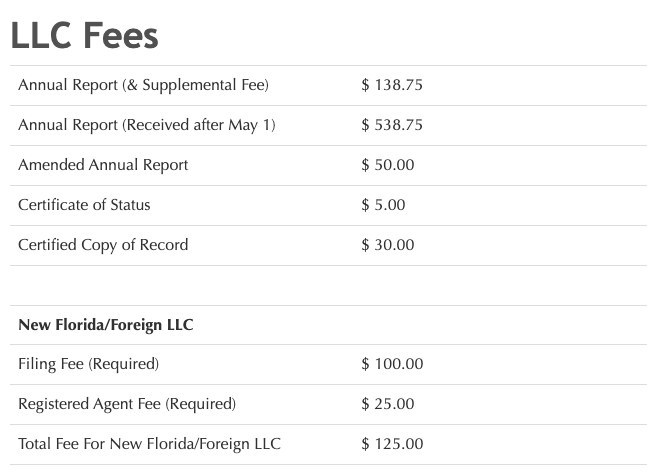
Florida’s own fee page, captured September 21, 2026. The late annual report costs $400 more than the on-time one.
Illinois, Pennsylvania and Ohio are missing on purpose. Their official fee pages would not load for me today, and a fee I could not read from the source does not belong in this table.
Three rows deserve a second look. A California LLC costs $890 in state charges in its first year ($70, $20 and $800) and $800 or $820 every year after, whether the channel earned $200,000 or nothing. New York’s filing fees look small, but the newspaper notices are billed by the papers themselves, vary by county, and are not on any state fee page, so get a quote before you file. And Texas is cheap to keep but not paperwork-free: the no-tax-due report went away for 2024 and later, the Public Information Report did not.
One more cost trap. Forming in Wyoming or Delaware while you live and film in California does not get you out of California’s bill. A home state generally expects an LLC doing business there to register as a foreign LLC, which means two sets of fees, and your personal state income tax follows where you live. Form where you work.
The decision tree
Answer these in order. Stop at the first one that gives you an instruction.

- Is the channel earning money, or clearly about to? If no, stop. There is no business to protect yet, and a sole proprietorship costs nothing.
- Is someone requiring an entity? A sponsor, agency, or platform contract that will only sign with a company decides it for you. Form the LLC.
- Are you signing contracts with deliverables, paying an editor or other contractor, or selling products, courses, coaching or events? These are the business-side risks an LLC actually covers. If yes, go to question 5. If the channel is ad revenue and affiliate links only, go to question 4.
- Is your main exposure what you say and show on camera? Then an LLC is the weaker tool, because claims about your own conduct can reach you personally. Put the first dollars into licensed music and footage and a quote for media liability insurance, and revisit when question 3 becomes a yes.
- Do you own things worth protecting outside the business? Home equity, savings, a paid-off car. If yes, the shield has something to shield. If you rent and your savings are thin, the LLC protects little today; waiting a year costs you less than it sounds.
- Can the channel pay your state’s recurring cost without you noticing? Use the table. $60 in Georgia is an easy yes. $800 in California is a real line item for a channel netting a few thousand dollars a year, and a reasonable one for a channel that pays your rent.
Yes on 3, 5 and 6 means form the LLC now, in your home state. A no on 5 or 6 means wait, and set up the sole-proprietor basics below. If 4 describes you, insure first.
If the answer is “wait”: the sole-proprietor setup
Waiting is not the same as doing nothing. Most of the day-to-day benefits people credit to an LLC are available without one.
Get an EIN. The IRS issues one free, online, and says you can request one for banking purposes even when you do not need it for federal tax purposes. That lets you hand sponsors a W-9 without your Social Security number on it.
Then open a separate account for channel income and expenses. The guide to a business bank account as a sole proprietor covers how. Clean separation now also makes the later move to an LLC a one-afternoon job instead of a bookkeeping dig.
My own bias, from shooting, editing and uploading a channel alone: every hour of admin comes out of the hours that make videos. A structure you can ignore until it matters is worth more to a solo operator than one that mails you compliance notices.
If the answer is “form”: the order of operations
File the formation document with your home state’s Secretary of State yourself; the state form is short, and the fee in the table is the whole state charge. The form asks for a registered agent, someone with an in-state street address who accepts legal mail. In most states that can be you, if you are fine with the address going on the public record.
Write a simple operating agreement even if your state does not demand one, because it is part of showing the company is separate from you. Get an EIN, open a bank account in the LLC’s name, and move channel income and expenses there. From then on, sign every sponsor and contractor agreement as the LLC, with your title after your name.
Skip one step you will see on older checklists. FinCEN states that U.S. companies are exempt from beneficial ownership information reporting and are no longer required to file BOI reports. Two of the pages ranking for this search still list it as mandatory.
Last, put the recurring filing on your calendar the day you form. Florida’s gap between on time and late is $400, and New York’s publication clock starts at 120 days. More money-side guides are in Money Ops.
Open your state’s fee page from the sources below, write the first-year and every-year numbers on one line, and write what you own outside the business on the next. If the second line is bigger than ten years of the first and question 3 was a yes, file this week.
Frequently asked questions
Do I need an LLC to monetize a YouTube channel?
No. The SBA says you are automatically a sole proprietorship once you do business without registering as anything else, and a sole proprietor can be paid ad revenue and sponsor fees. An LLC is a choice about liability and how you sign contracts, not a requirement for getting paid.
Does an LLC lower a YouTuber's taxes?
Not by itself. The IRS treats a one-member LLC as a disregarded entity: the income still lands on Schedule C, and the owner owes self-employment tax the same way a sole proprietor does. Any tax change comes from a separate election to be taxed as a corporation, which brings payroll and a reasonable-salary requirement.
Should I form my LLC in Wyoming or Delaware instead of my home state?
Usually not if you live and film in one state. Your home state generally still expects an LLC doing business there to register as a foreign LLC, so you would pay two sets of state fees and keep two registered agents, and your personal state income tax does not change.
Can I get an EIN without forming an LLC?
Yes. The IRS issues EINs free of charge and says you can request one for banking purposes even if you do not need it for federal tax purposes. A sole proprietor can use that EIN on W-9 forms instead of a Social Security number.
Do I have to file a BOI report for a new LLC?
Not for an LLC created in the United States. FinCEN's beneficial ownership page states that U.S. companies are exempt from BOI reporting and are no longer required to file. Formation checklists that still list a BOI report as a step are out of date.
Sources
- SBA: Choose a business structure
- IRS: Single member limited liability companies
- IRS: Limited liability company (LLC)
- IRS: Self-employment tax (Social Security and Medicare taxes)
- IRS: S corporation compensation and medical insurance issues
- IRS: Employer identification number
- FinCEN: Beneficial ownership information reporting
- U.S. Copyright Office: Title 17, Chapter 5 (section 504, damages)
- California Secretary of State: LLC forms and fees
- California Franchise Tax Board: Limited liability company
- Texas Secretary of State: Form 806, business filings fee schedule
- Texas Comptroller: Franchise tax filing requirements
- Texas Comptroller: Franchise tax
- Florida Division of Corporations: LLC fees
- New York Department of State: Forming a limited liability company
- New York Department of State: Biennial statements
- New York Department of Taxation and Finance: LLC annual filing fee
- Washington Secretary of State: Fee schedule
- North Carolina Secretary of State: LLC fees
- Georgia Secretary of State: Corporations Division filing fees
This article is general information based on the author's experience. It is not licensed financial, legal, or tax advice. See the editorial policy.