App Store Small Business Program: Rules, Enrollment, Real Math
Apple's 15% rate for developers with up to $1M in prior-year proceeds: who qualifies, how to enroll, when the rate starts, and what it pays per sale.

The App Store Small Business Program cuts Apple’s commission on paid apps and In-App Purchases to 15%, down from the standard 30%. You qualify if you and any associated developer accounts earned no more than $1 million in proceeds in the prior calendar year, or if you are new to the App Store. It is not automatic. You enroll, and the rate starts 15 days after the end of the Apple fiscal month in which you are approved.
I’ve shipped my own apps and I’m promoting them through outreach now, and small indie developers are the group this program was built for. For an app at that stage, the decision takes one line: enroll before the first paid release, because Apple never backdates the rate.
This is not licensed tax or financial advice. Apple’s program page is the source for every rule below, and the IRS’s Form 1099-K page covers how App Store income is reported.
Who qualifies for the Small Business Program
Eligibility is measured in proceeds, not sales. Apple defines proceeds as your sales after its commission and certain taxes and adjustments. Two limits apply at once: no more than $1 million in proceeds across the 12 fiscal months that fall inside the previous calendar year, and no more than $1 million so far in the current year.
Developers with no App Store history qualify too. If you are about to ship your first paid app, you are already eligible.
Because the cap is on proceeds, it sits higher than it sounds in customer spend. At the program rate, $1 million in proceeds equals about $1,176,471 in pre-tax sales ($1,000,000 ÷ 0.85). For an account still on the standard rate it equals about $1,428,571 ($1,000,000 ÷ 0.70). Apple’s own estimate method works from the other end: total the App Store deposits that hit your bank in the prior calendar year, then adjust for the taxes and adjustments in Payments and Financial Reports.
Associated developer accounts
Apple adds the proceeds of every associated developer account to yours. An account counts as associated if any of these is true:
- You hold more than 50% of the ownership of another developer account.
- Another developer account holds more than 50% of yours.
- You have final decision-making authority over another developer account.
- Another account has final decision-making authority over yours.
App transfers count as well. When an app moves between accounts, that calendar year’s proceeds attach to both the account that sends it and the one that receives it. Splitting apps across two accounts you control does not reset the cap.
How to enroll
Apple lists three requirements:
- You are the Account Holder in the Apple Developer Program. Apple names that role specifically, so a teammate with another role cannot enroll for you.
- The latest Paid Apps agreement (Schedule 2 of the developer agreement) is accepted in App Store Connect.
- Any associated developer accounts are listed.
Check step 2 before you start. In App Store Connect, select Business, then the Agreements tab; the Paid Apps agreement should read Active. A status of New, Pending User Info, or Active (New Agreement Available) means something is waiting on you.
For each associated account, the form asks for four details: the individual or organization name, the Team ID, the Account Holder’s email, and a description of how the two accounts are related. Gather those before you open the form, which is linked from Apple’s program page behind your developer sign-in.
If you run a single individual account with no other companies involved, there is nothing to list. That is the common case for a solo developer, and the form takes a few minutes.
When the 15% rate starts
Apple waits for the fiscal month of your approval to close, then switches your proceeds to the program rate 15 days later. Apple’s own example: approval on February 10, 2022 meant adjusted proceeds starting March 14, 2022. More than a month passed between approval and the first sale at 15%.
Two details drive that gap. Apple counts by its own fiscal calendar, whose months do not match calendar months, so the end of the month in question may be weeks away. And the clock starts at approval, not application.
Apple does not publish how long approval itself takes. Plan for the wait by enrolling well before any launch push, not the week of it.
Checklist: from approval to the first deposit at 15%
- Note the date Apple approves the enrollment.
- Find the end of that fiscal month in the fiscal calendar inside App Store Connect.
- Add 15 days. Sales from that date carry the program rate.
- Find the end of the fiscal month those sales fall in.
- Add up to 45 days. Apple pays proceeds within 45 days of the last day of the fiscal month in which the sale happened.
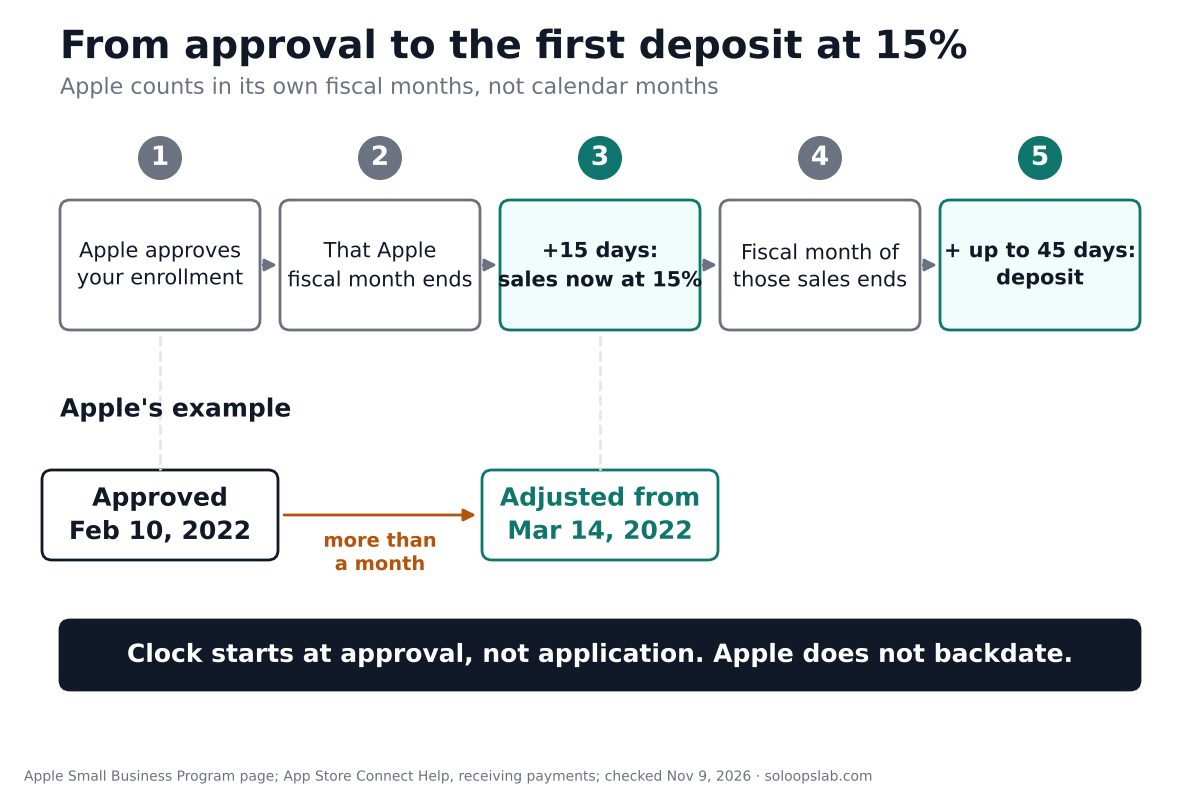
Put dates 3 and 5 on your calendar. The full payment rule, the fiscal month dates, and what can delay a deposit are covered in App Store payout schedule and taxes.
How to check your enrollment status
Apple’s program page and App Store Connect help describe no status screen for the program. Keep whatever email Apple sends about your request; it is the only record you have that the review is open.
The check that matters comes after the start date. Every App Store financial report carries a Partner Share column, which Apple defines as the proceeds you receive per unit after taxes and Apple’s commission. On a $0.99 sale with no tax in the price, Partner Share near $0.84 means the program rate is live, and $0.69 means it is not.
If the start date has clearly passed and Partner Share has not moved, contact Apple Developer Support through the link at the bottom of the program page.
What 15% is worth per sale
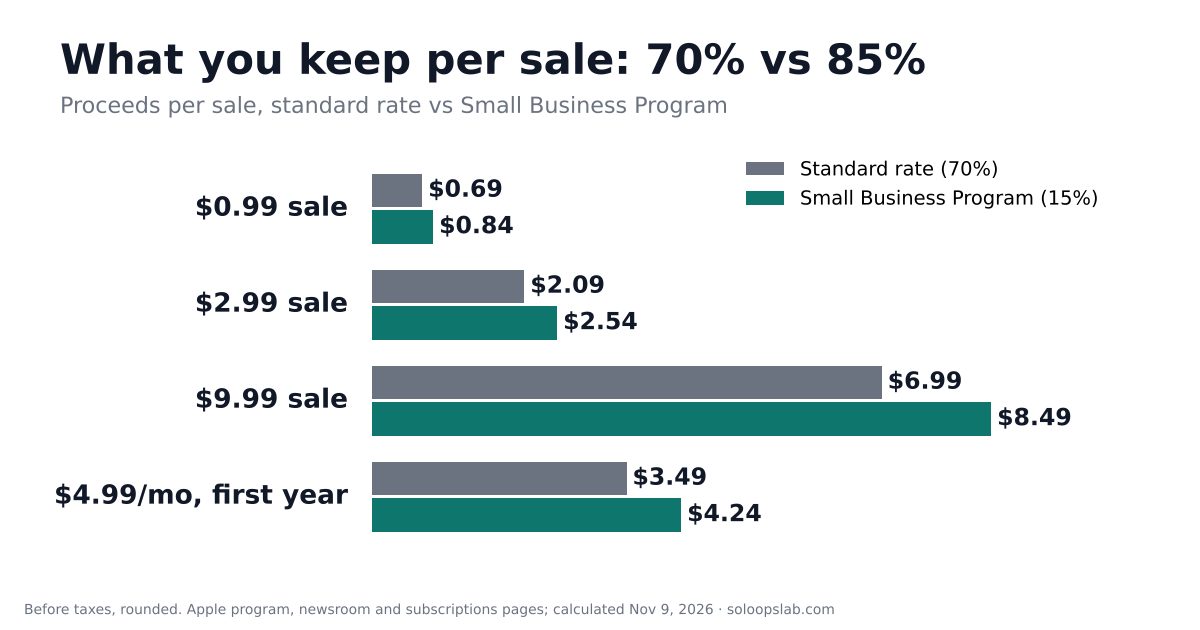
Proceeds per sale at the standard rate and the program rate, before taxes, rounded to the cent:
| Price | Standard rate (you keep 70%) | Small Business Program (you keep 85%) | Difference per sale |
|---|---|---|---|
| $0.99 one-time purchase | $0.69 | $0.84 | $0.15 |
| $2.99 one-time purchase | $2.09 | $2.54 | $0.45 |
| $9.99 one-time purchase | $6.99 | $8.49 | $1.50 |
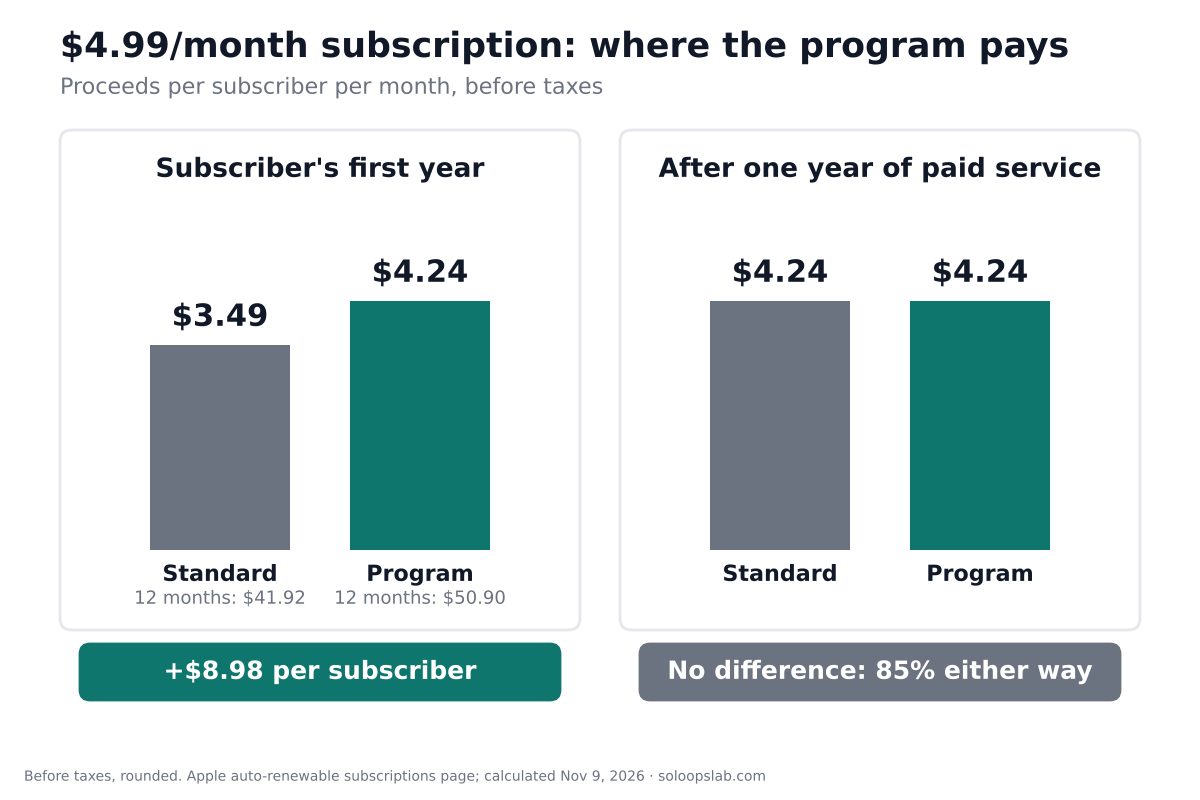
| $4.99/month subscription, subscriber’s first year | $3.49 | $4.24 | $0.75 |
| $4.99/month subscription, after one year of paid service | $4.24 | $4.24 | $0.00 |
| $49.99/year subscription, first year | $34.99 | $42.49 | $7.50 |
Sources: Apple Small Business Program page (15%), Apple Newsroom (30% standard), Apple auto-renewable subscriptions page (70% first year, 85% after); calculated Nov 9, 2026. Your report’s Partner Share, after taxes, is the exact figure.
Over a subscriber’s first 12 months at $4.99, the program is worth $8.98: $50.90 against $41.92.
The fifth row is the one vendor explainers skip. Once a subscriber has a year of paid service, Apple pays 85% whether or not you are enrolled. Enrolled developers get 85% from the first billing cycle. So for a subscription app, the program’s money comes from first-year subscribers, plus every one-time purchase.
Free trials and renewal extensions do not count toward that year of paid service, and the count is kept per subscription group. If a subscriber lapses for more than 60 days, the count resets. An app with heavy churn and few long-term subscribers gains the most from enrolling.
What happens if you cross $1 million
If your proceeds pass $1 million during the current calendar year, Apple applies the standard commission to future sales. Sales before that point keep the 15% rate. If your proceeds later fall back under $1 million for a calendar year, you can qualify for 15% again the year after.
Do not throttle growth to stay under the line. Every sale past $1 million still adds 70 cents per dollar of pre-tax price, and any calendar year that ends back under $1 million lets you requalify the year after.
US link rules and the EU terms
Two recent changes sit next to this program. Neither changes the decision to enroll.
In the United States storefront, Apple’s App Review Guidelines now allow buttons, external links, and other calls to action that point to purchase methods other than In-App Purchase, without a special entitlement. The 15% program rate is defined for paid apps and Apple In-App Purchases, so it applies to whatever you still sell through Apple.
In the EU, Apple moved apps to a single set of terms effective October 1, 2026. Under those terms, In-App Purchase sales are charged 26% as standard and 15% for Small Business Program participants and subscriptions after their first year; sales through alternative in-app payment processing are 20% and 10%. The program page’s older FAQ line about a 10% EU rate refers to the alternative-terms setup that the October change replaced.
One more benefit is listed on the program page. Enrolled developers whose apps have under two million first-time downloads can use Apple Foundation Models on Private Cloud Compute with no cloud API cost, once the entitlement is assigned.
If your first app is out or close, check that the Paid Apps agreement reads Active in App Store Connect today, then submit the enrollment form from Apple’s program page before you spend another hour on promoting the app. More guides on the money side of an app business are under money ops.
Frequently asked questions
How do I enroll in the App Store Small Business Program?
Sign in as the Account Holder of your Apple Developer Program membership, make sure the latest Paid Apps agreement shows Active under Business > Agreements in App Store Connect, then submit the enrollment form linked from Apple's program page. If you own or control another developer account, or one controls yours, list each with its name, Team ID, Account Holder email, and how the two are related.
How do I check my App Store Small Business Program status?
Apple's program page and App Store Connect help describe no status screen for the program. Keep the email Apple sends about your request, and once the start date should have passed, open a financial report and check Partner Share: on a $0.99 sale before tax it should read about $0.84, not $0.69. If nothing has moved, contact Apple Developer Support from the link on the program page.
How long does App Store Small Business Program approval take?
Apple does not publish a review time. What it does publish is the start date after approval: your proceeds change 15 days after the end of the Apple fiscal month in which you are approved. In Apple's own example, approval on February 10, 2022 meant adjusted proceeds starting March 14, 2022.
Is the 15% rate retroactive to when I applied?
Apple ties the change to the approval date, not the application date: proceeds are adjusted from 15 days after the end of the fiscal month in which enrollment is approved. Apple's page describes no refund of the difference on earlier sales, so sales before the start date stay at the standard rate.
What happens if I go over $1 million in the Small Business Program?
If your proceeds pass $1 million during the current calendar year, Apple applies the standard commission to future sales. Earlier sales that year keep the 15% rate. If your proceeds later fall back under $1 million for a calendar year, you can qualify for 15% again the year after.
Sources
- Apple Developer: App Store Small Business Program
- Apple Newsroom: Apple announces App Store Small Business Program (Nov 2020)
- Apple Developer: Auto-renewable subscriptions
- App Store Connect Help: View agreements status
- App Store Connect Help: Financial report fields
- App Store Connect Help: Overview of receiving payments
- App Store Review Guidelines
- Apple Developer: Digital Markets Act and apps in the EU
- Apple Developer: Membership programs overview
- IRS: Understanding your Form 1099-K
This article is general information based on the author's experience. It is not licensed financial, legal, or tax advice. See the editorial policy.