Sales Tax on Digital Products and Ebooks: Who Collects It
Do you owe sales tax on ebooks, courses or templates? Which platforms collect it for you, which states tax ebooks, and the nexus thresholds that matter.

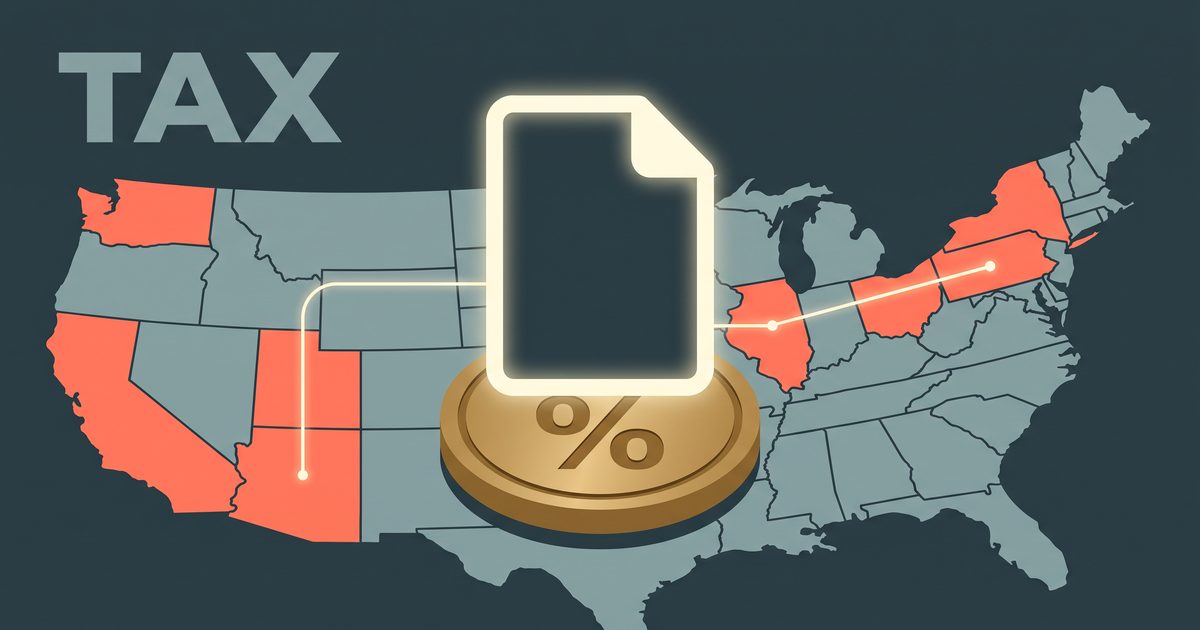
Usually not, if every sale runs through a merchant of record such as Gumroad, Lemon Squeezy, Payhip or Etsy: the platform is legally the seller, so it collects and remits US sales tax for you. If you sell direct through your own Stripe or Shopify checkout, you owe it only in states that tax your kind of product and where you have nexus, which for most solo sellers means the home state first. Ebooks are a good example of the split: Pennsylvania, Washington and North Carolina tax them, while California, Florida and Illinois generally don’t.
This is not licensed tax or legal advice. Every platform and state detail below was re-checked on official pages on October 26, 2026, and each state page is linked so you can check your own case, starting with your state revenue department. The federal side, from 1099s to quarterly payments, is collected in the creator tax guide.
Three conditions that all have to be true
You owe a state sales tax on a digital sale only when all three of these line up:
- The product is taxable in the buyer’s state. Ebooks are taxed in some states and exempt in others.
- You have nexus in that state, either from physical presence or from crossing its sales threshold.
- Nobody else is legally the seller. A merchant of record or marketplace facilitator takes the obligation for sales made through it.
Most guides spend all their time on the first condition. For a solo seller, the third is the one you control with a single decision.
Merchant of record vs not: who collects for you (October 2026)
Each row below comes from the platform’s own help page, pricing page or developer agreement, re-checked on October 26, 2026. “Yes” in the second column means the platform is the legal seller for US sales tax, so you don’t collect on those sales.

| Where you sell | Collects and remits US sales tax for you? | Basis | What stays with you |
|---|---|---|---|
| Gumroad | Yes | Merchant of record since Jan 1, 2025; also VAT and GST worldwide | Income tax |
| Lemon Squeezy | Yes | Merchant of record; also international taxes such as VAT | Income tax on payouts |
| Payhip | Yes, since Jul 1, 2026 | US marketplace facilitator, at no charge; Canadian GST/HST and PST from the same date; digital EU and UK VAT by default | Quebec QST; possible zero-dollar returns where you’re physically present; income tax |
| Stripe Managed Payments | Yes | Stripe is merchant of record; sales tax, VAT and GST in more than 80 countries | Passing an eligibility review; fully automated products only; income tax |
| Etsy | Yes | Collects on digital orders by US buyers; sellers can’t opt out | Tax on anything you sell off Etsy |
| Apple App Store | Yes | Collects US state and local tax it believes is due | Primary liability for any tax Apple didn’t collect; income tax |
| Google Play | Yes, for Play billing | Collects in every state with a statewide sales tax, plus DC and Alaska localities | Sales tax on alternative-billing purchases |
| Stripe, standard checkout | No | You are the seller; Stripe Tax calculates and collects where you register | Registering, filing and remitting everywhere you’re registered |
| Shopify, your own store | No | You are the seller; Shopify charges tax at checkout | Filing and remitting, unless you set up Shopify Tax automated filing |
Payhip is the row most articles still have wrong. Its US help page, updated October 4, 2026, says it began collecting and paying US sales tax on July 1, 2026, as a marketplace facilitator, and charges sellers nothing for it. Canada changed on the same date: Payhip took over GST/HST and PST, but Quebec QST remains yours if you’re required to collect it. One footnote stays with you on the US side too. If you have a physical presence in a state where Payhip collects, Payhip says you may still need to file a zero-dollar return there.
Gumroad’s page carries a detail that matters if you sell in more than one place. If you already file sales tax returns because of your direct sales, Gumroad says to report your Gumroad sales as sales to another retailer for resale, and it provides a reseller certificate to keep on file for that.
Stripe is two different products. Standard Stripe makes you the seller, and Stripe’s docs say plainly that you must file and remit the tax you collect for every location where you’re registered. Managed Payments flips that and makes Stripe the merchant of record. The fee math for both is in Stripe vs PayPal for digital products, and the three creator platforms are compared on fees and payouts in Gumroad vs Lemon Squeezy vs Payhip. If you ship apps, the store side is covered in App Store payouts and taxes.
Apple’s agreement has one sentence worth reading twice. Apple collects and remits US state and local sales tax it believes is due, but to the extent it hasn’t collected that tax, the developer stays primarily liable. In practice the store handles it. On paper, it’s still your name.
Amazon KDP is missing from the table on purpose. On October 26, 2026, KDP’s help pages covered VAT included in ebook list prices in certain marketplaces and US income tax reporting, but none of the pages checked said who collects US sales tax on Kindle ebooks. Until Amazon states it, there’s no row.
I sold an ebook of my own before shutting it down, once sales stopped the moment I stopped paying for ads. That taught me to look at the cost of each buyer first. The checkout choice still matters, though, because it decides whether a tax obligation comes attached to every sale or stays with the platform.
Do I need to charge sales tax on ebooks?
Only when you are the seller, the buyer’s state taxes digital books, and you have nexus in that state. Through any “Yes” row above, the answer is no. Selling direct, it depends on where the buyer lives, not where you live.
Each cell below comes from that state’s own revenue department, re-checked October 26, 2026. Texas, Ohio and Georgia are left out because their official pages didn’t confirm ebook taxability.
| State | Ebooks and similar downloads taxable? | Source type |
|---|---|---|
| Pennsylvania | Yes, 6%: e-books, digital audio and video, apps and games, photographs | Department page on digital products |
| Washington | Yes: all digital products, downloaded or streamed, permanent right of use or not | Department tax topic |
| North Carolina | Yes: digital books, audio and audiovisual works, publications, photographs, greeting cards | Department page on certain digital property |
| California | Generally no when sent over the internet; adding a printed copy or a backup on a flash drive usually makes the entire sale taxable | Publication 109 |
| Florida | No: the advisement says Florida law does not currently tax electronic books | Technical Assistance Advisement 14A-010 (2014) |
| Illinois | No for downloaded books, music, newspapers or magazines; downloaded canned software is taxable | General Information Letter (2025), not binding |
| New York | Not taxable for e-books meeting the department’s e-book definition | Advisory Opinion TSB-A-11(20)S (2011) |
Two cautions on the “no” rows. New York’s answer comes from an advisory opinion, which binds the department only for the business that asked, on the facts it gave. Its e-book definition has conditions, such as delivery as a single download, marketing as an e-book, and new editions no more than once a year. Illinois exempts downloaded books but taxes downloaded canned software, so a product that behaves like software may land on the other side.
Ebook, template, course, preset: the label matters
States don’t tax “digital products” as one bucket. They tax categories, and the category your file falls into can change the answer.
Stripe’s own tax codes show how finely this gets sliced: digital books, downloadable software for personal use, and on-demand online courses each get separate codes, with courses split again by whether video is streamed or also downloadable. Illinois draws its line between downloaded books, which it doesn’t tax, and canned software, which it does.
Where does a Notion template, a spreadsheet with formulas, or a photo-editing preset fall? None of the state pages above name them. If your product works more like a tool than a document, put that exact question to the state or a tax professional before assuming it’s an ebook. The answer genuinely differs by state.
Economic nexus after Wayfair, in plain terms
Until 2018, a state could make you collect only if you had a physical presence there. On June 21, 2018, the Supreme Court decided South Dakota v. Wayfair and overruled that physical-presence rule. The South Dakota law it upheld applied to sellers delivering more than $100,000 of goods or services into the state, or making 200 or more separate transactions, each year.

States then wrote their own versions of that test, and the versions keep drifting apart.
The 200-transaction test is disappearing. South Dakota itself dropped it effective July 1, 2023, leaving only the $100,000 gross sales test. Indiana has used only its $100,000 threshold since January 1, 2024. Illinois followed on January 1, 2026, and its bulletin says the 200-transaction threshold no longer applies. For a seller of $15 templates, that is real relief: under the old rule, 200 small sales could create nexus long before $100,000 in revenue.
Economic nexus thresholds at a glance
Ten states, each threshold taken from that state’s revenue department on October 26, 2026. The last column is the detail most summaries skip: whether sales of things the state doesn’t tax still count toward the line.
| State | Threshold | Period | Transaction count? | Nontaxable sales count? |
|---|---|---|---|---|
| South Dakota | Over $100,000 gross sales | Previous or current calendar year | Dropped Jul 1, 2023 | Gross sales |
| Indiana | Over $100,000 gross sales | Previous or current calendar year | Dropped Jan 1, 2024 | Gross sales |
| Illinois | $100,000 or more in gross receipts | 12-month lookback, rechecked quarterly | Dropped Jan 1, 2026 | Gross receipts |
| Pennsylvania | $100,000 in gross sales | Calendar year | No | Yes, taxable and nontaxable |
| Washington | Over $100,000 in gross receipts | Current or prior year | No | Yes, exempt sales included |
| North Carolina | Over $100,000 in gross sales | Previous or current calendar year | None listed | Gross sales |
| Florida | Over $100,000 in taxable remote sales | Previous calendar year | No | No, taxable sales only |
| Texas | $500,000 in total Texas revenue | Preceding 12 calendar months | No | Yes, taxable and nontaxable |
| California | Over $500,000 in sales of tangible personal property | Preceding or current calendar year | No | Counts tangible property sales |
| New York | Over $500,000 and more than 100 sales of taxable tangible personal property | Prior four sales tax quarters | Yes, both tests | Taxable sales only |
Read the last column before you assume your exempt ebook sales don’t count. In Texas, Pennsylvania and Washington, gross revenue counts whether or not it was taxable, so sales of a product the state exempts can still push you toward registering. Florida’s wording counts only taxable remote sales.
Timing differs too. Washington says a seller who crosses its threshold mid-year starts collecting on the first day of the month that begins at least 30 days later. North Carolina changed its rule effective July 2, 2026: a seller whose only nexus is the threshold becomes engaged in business on the first day of the first calendar month at least 60 days after crossing it.
The pattern a solo seller should take away: the states that tax ebooks here use $100,000 thresholds, while California and New York, which mostly don’t tax them, sit at $500,000. If you’re nowhere near $100,000 of sales into any one state, economic nexus is a future problem. Your home state is not.
Your home state works differently
Thresholds are for remote sellers. In the state where you live and work, you have physical presence from your first sale, so the threshold doesn’t protect you there.

The question at home is only whether your product is taxable. A Washington seller selling templates direct to Washington buyers is in a state that taxes all digital products, however they’re accessed. A California seller emailing PDFs to California buyers is generally not making taxable sales, unless a physical copy goes along with them.
If your home state taxes digital goods and you sell direct, that’s the one registration to sort out now, even at $500 a year.
If you register: Stripe Tax, filing, and the free option
Collecting is only half of it. Stripe Tax Basic costs 0.5% per transaction where you’re registered on the no-code integration, as of October 2026, and it calculates and collects. Filing is a separate service: Stripe’s Tax Complete plans bundle filings starting at $90 a month for four filings a year, or you file yourself from Stripe’s tax reports.
There is a lesser-known route in the states that belong to the Streamlined Sales Tax agreement. A remote seller that has to collect in a member state only because it crossed that state’s economic nexus threshold can qualify for a Certified Service Provider paid by the state. That covers tax calculation, preparing and filing returns, and remittance for that state. It doesn’t cover your home state, where you have a physical presence.
Selling direct vs through a merchant of record
Answer these seven questions before you pick or switch a checkout. A “yes” pushes toward a merchant of record or marketplace; a “no” makes selling direct easier to justify.

- Do you sell to buyers outside the US? A merchant of record such as Gumroad, Lemon Squeezy or Stripe Managed Payments also handles VAT and GST, which a solo seller otherwise has to register for country by country.
- Does your home state tax digital goods? If yes, selling direct means registering and filing at home from the first sale.
- Will your sales into any single state approach $100,000 in a year? Past that, direct selling means more registrations, each with its own filing calendar.
- Is your product fully automated? Stripe’s merchant-of-record option excludes anything with human intervention, such as live 1:1 coaching, so a course with live calls may not qualify.
- Would you rather not file returns monthly or quarterly? Stripe Tax collects, but filing is a separate step you set up, pay for, or do yourself.
- Is a few extra percent per sale acceptable? As of October 2026, Stripe Managed Payments adds 3.5% per transaction on top of Stripe’s 2.9% + 30¢ domestic card rate, Gumroad charges 10% + 50¢ on direct sales, and Lemon Squeezy charges 5% + 50¢.
- Can you live without your own checkout page and full control of the customer list? If yes, the platform route is the simpler default.
If most of your answers were no, selling direct with Stripe Tax Basic is reasonable. Otherwise, start on a merchant of record and revisit when revenue justifies the paperwork. To see what each option leaves you per sale, run your price through the digital product fee calculator, and if the fee changes your price, the reasoning is in how to price a digital product.
If you’ve been selling direct without collecting
Don’t quietly start collecting next month and hope the past disappears. If you already crossed a threshold, or you’ve been making taxable sales in your home state, the earlier periods are still open.
States have a formal route for this. The Multistate Tax Commission runs a voluntary disclosure program in which a state knows you only by a case number until you sign. You file returns and pay the tax for the lookback period, plus interest unless the state waives it, and register if required. In return, penalties for the lookback period are waived and earlier periods are not pursued. Talk to a tax professional before applying; the lookback length and the states involved are where the money is.
What a merchant of record doesn’t take off your plate
A merchant of record takes sales tax and VAT. It does not take income tax. Lemon Squeezy’s docs say it directly: you may still owe tax on the income you receive as payouts.
The IRS is just as direct about reporting. Even if no Form 1099-K arrives, payments you received for goods, services or property are income you must report. The difference between the forms that can arrive is in 1099-NEC vs 1099-K for creators, and the rest of the money side lives under money ops.
This week, export the last 12 months of direct sales from Stripe or Shopify, group them by the buyer’s state, and check your home state and any state over $100,000 against the two tables above. If your home state taxes your product, register or move those sales to a merchant of record before the next one comes in.
Frequently asked questions
Do I need to charge sales tax on ebooks?
Only if you sell direct and the buyer's state taxes digital books and you have nexus there. Pennsylvania, Washington and North Carolina tax ebooks on their revenue department pages; California, Florida and Illinois generally don't. If you sell through a merchant of record such as Gumroad, Lemon Squeezy or Payhip, the platform collects instead of you.
Does Gumroad collect sales tax for me?
Yes. Gumroad's pricing page says that since January 1, 2025 it handles sales tax collection and remittance worldwide as the merchant of record, and it disables the tax settings in your dashboard. That covers sales made through Gumroad only. Sales through your own Stripe or Shopify checkout are still yours to handle, and income tax on your payouts is always yours.
Does Payhip collect US sales tax now?
Yes. Payhip's help center says that from July 1, 2026 it collects and pays US sales tax as a marketplace facilitator and charges sellers nothing for it. It took over Canadian GST/HST and PST on the same date, except Quebec QST. If you have a physical presence in a state, Payhip notes you may still need to file a zero-dollar return there.
Do I need a sales tax permit if I only sell digital downloads on Etsy?
Not for the Etsy sales themselves. Etsy says it calculates, collects and remits US sales tax on digital orders bought by US buyers, and sellers can't opt out. The permit question comes back only if you also sell somewhere else, such as your own site, into a state where the product is taxable and you have nexus, including your home state.
Sources
- Gumroad pricing (merchant of record since January 1, 2025)
- Lemon Squeezy Docs: Sales tax and VAT
- Lemon Squeezy pricing
- Payhip Help Center: US Sales Tax (updated October 4, 2026)
- Payhip Help Center: Canada Sales Tax (updated October 3, 2026)
- Payhip Help Center: Digital EU VAT & UK VAT (updated July 9, 2026)
- Stripe Docs: File and remit (Stripe Tax)
- Stripe Tax pricing
- Stripe Docs: Managed Payments
- Stripe Docs: Managed Payments eligibility
- Stripe pricing
- Shopify Help Center: US taxes
- Etsy Help: How US State Sales Tax and Fees Applies to Etsy Orders
- Apple: Exhibits to Schedule 2 and 3 (August 21, 2025)
- Play Console Help: Tax rates and value-added tax
- KDP Help: Price Your Book
- U.S. Supreme Court: South Dakota v. Wayfair, Inc. (June 21, 2018)
- South Dakota DOR: 2023 Legislative Updates
- Indiana DOR: Remote sellers
- Illinois DOR: Bulletin FY 2026-12
- Illinois DOR: General Information Letter ST 25-0047-GIL (September 9, 2025)
- Texas Comptroller: Remote sellers
- Florida DOR: Tax Information Publication 21A01-03
- Florida DOR: Technical Assistance Advisement 14A-010
- CDTFA Publication 109: Internet Sales, Nontaxable Sales
- CDTFA: Wayfair implementation (remote sellers)
- New York DTF: Advisory Opinion TSB-A-11(20)S, e-books
- New York DTF: Do I need to register for sales tax?
- Pennsylvania DOR: Digital products
- Pennsylvania DOR: Online retailers
- Washington DOR: Digital products including digital goods
- Washington DOR: Remote sellers
- North Carolina DOR: Certain digital property
- North Carolina DOR: Remote sales
- Streamlined Sales Tax: Free services from Certified Service Providers
- Multistate Tax Commission: Multistate Voluntary Disclosure Program
- IRS: What to do with Form 1099-K
This article is general information based on the author's experience. It is not licensed financial, legal, or tax advice. See the editorial policy.