How to Pay Yourself as a Solopreneur: Draw, Salary, or Split
Owner's draw, S corp salary plus distributions, or a fixed-percentage split: how each way to pay yourself works and what the IRS taxes, with every rule sourced.


The usual way a one-person business pays its owner is informal: when the business account looks full, some of it moves to the personal account. That holds up until April, when the tax bill arrives on money that is already spent. There are three sound ways to pay yourself as a solopreneur, your structure decides which ones you can use, and this guide puts all three in one table with the tax consequence of each, then lists the six mistakes that cost the most.
This is general information, not licensed tax or legal advice. Every rule below links to the IRS page it comes from, starting with the agency’s own Paying yourself overview. Check your own numbers with a tax professional before you change how your business is set up. More guides like this live under Money Ops.
Your business structure picks the method
How you pay yourself is not a preference. The IRS says the procedure depends on the type of business structure you elect.
For a solopreneur that comes down to two tracks. If you run as a sole proprietor, or as a single-member LLC that never filed an election, you are not an employee of your own business. The IRS treats a one-member LLC as disregarded from its owner for income tax, has the owner report its activity on Schedule C, and applies self-employment tax to that owner the same way it does to a sole proprietor. You pay yourself with a draw.
If the LLC or corporation has elected S corporation status, you become a shareholder who also works for the company. That brings a W-2 wage and, on top of it, distributions.
One myth needs to go before the table. Some payroll guides say a single-member LLC taxed as a sole proprietorship can put the owner on salary. Payroll software will cut the check, but the Schedule C instructions tell you not to include amounts paid to yourself on the wages line. The tax result is still a draw.
The three methods side by side
The table consolidates what the IRS says about each method. Values were collected from irs.gov and ssa.gov on September 28, 2026. The third row is not a legal structure. It is a cash routine, and that difference is the reason it’s in the table.
| Owner’s draw | S corp salary plus distributions | Fixed-percentage split (Profit First style) | |
|---|---|---|---|
| Who can use it | Sole proprietor; single-member LLC with no election | LLC or corporation that filed Form 2553 | Anyone, layered on either of the other two |
| How money moves | Transfer or check from the business account to you, any time | Payroll wage first, then distributions from remaining profit | Each deposit split into tax, operating and owner accounts on a set day; you pay yourself a flat amount from the owner account |
| What gets taxed | All Schedule C net profit, withdrawn or not | The wage, plus your share of company profit on your personal return | Nothing new; tax follows the method underneath |
| Social Security and Medicare | Self-employment tax of 15.3%; the Social Security part covers earnings up to $184,500 in 2026 | Payroll taxes on the wage; distributions are non-wage payments not subject to employment taxes if the wage is reasonable | Same as the method underneath |
| Extra paperwork | Schedule C, Schedule SE, quarterly estimates | Payroll filings, a W-2 for you, Form 1120-S | Extra bank accounts and a fixed split schedule |
| IRS basis | Schedule C line 26 instructions; single-member LLC page; self-employment tax page | S corporation compensation page; Form 2553 instructions | None; the IRS taxes profit, not transfers between your own accounts |
Read the third column as a warning, not a tip. Moving money into an account named Taxes pays no tax. It only guarantees the money exists when a payment is due.
Method 1: the owner’s draw
This is the right default for nearly every new solo business.
The mechanics are one transfer. The tax is where people get it wrong. A sole proprietor’s taxable income is the net profit on Schedule C, not the total of transfers to the personal account, so leaving half the profit in the business account all year does not shrink the bill. The draw itself is not deductible either, because the wages line on Schedule C excludes amounts paid to yourself.
Two taxes land on that profit. Income tax, at your personal rates. And self-employment tax: 12.4% for Social Security plus 2.9% for Medicare, 15.3% in total, owed once your net earnings from self-employment reach $400 for the year. The Social Security part stops at $184,500 of earnings in 2026, and you can deduct the employer-equivalent portion of the tax when you figure adjusted gross income. The full calculation, with a worked example, is in self-employment tax explained.
How you take the draw matters more than people expect. IRS Publication 583 tells owners to keep the business checking account separate from the personal one, to write checks payable to yourself only when withdrawing money for personal use, and to avoid checks payable to cash. The modern version is a bank transfer with a memo that reads “owner draw.” One line in the books per draw, and nobody has to guess in March what that money was.
Method 2: S corp salary plus distributions
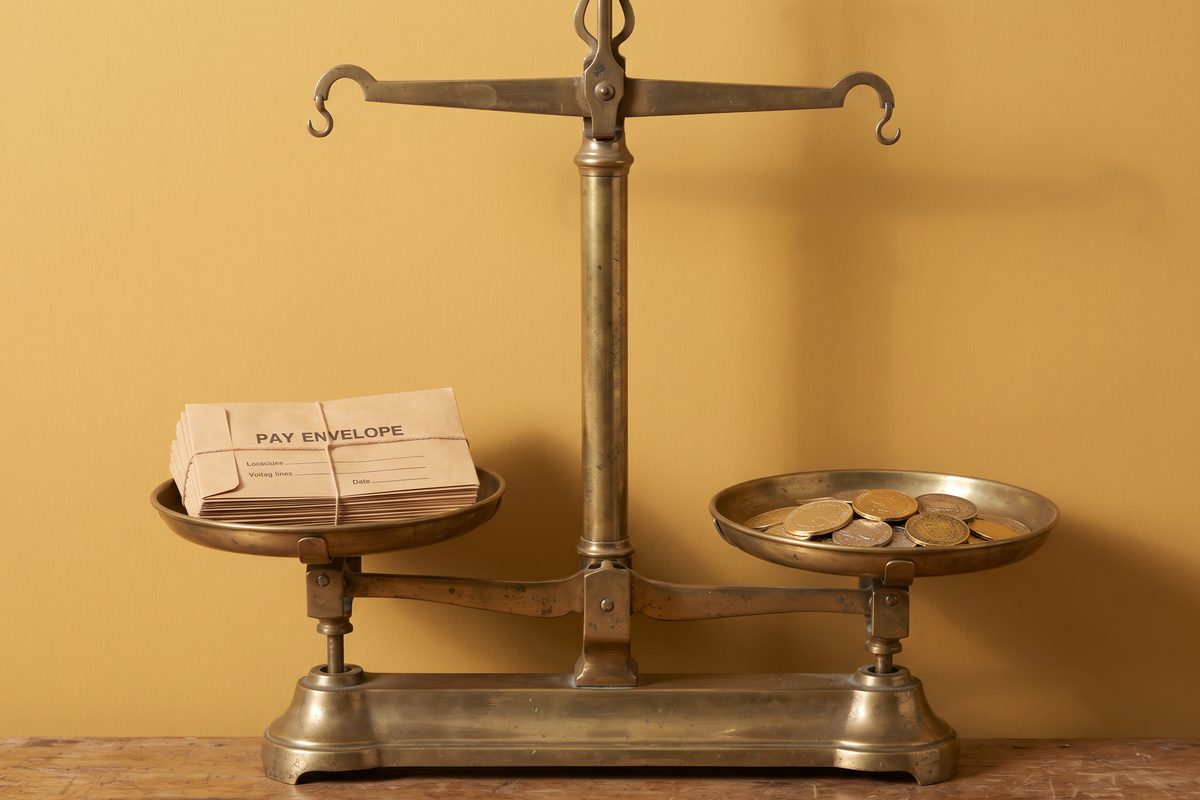
An S corporation election changes your relationship with your own business. You become a shareholder-employee, and the IRS says the company must pay you reasonable compensation for your services before it makes non-wage distributions to you. The payoff is that those distributions are not subject to employment taxes. The catch is that the IRS can reclassify distributions as wages, and its page lists the court cases that back that authority.
The election runs on a clock. Form 2553 is due no more than 2 months and 15 days after the start of the tax year it should cover, or at any time during the year before. An LLC that files it is treated as a corporation from the effective date without a separate Form 8832.
What “reasonable” means when you are the whole company
The IRS gives a test that the popular guides on this topic skip: look at where the company’s gross receipts come from. It names three sources, which are the shareholder’s own services, the services of employees who are not shareholders, and capital and equipment. Receipts produced by the owner’s own work should go out as wages. Receipts produced by staff or equipment can go out as distributions.
Now apply that to a YouTube creator, a newsletter writer or a solo app developer. There are no other employees. The equipment is a laptop and a camera. Nearly every dollar comes from the owner’s work, so the test pushes the wage up, not down.
The same IRS page lists the factors behind the number, from training and experience to duties, time devoted to the business, what comparable businesses pay for similar services, compensation agreements and the use of a formula. A workable version for a solo operator: what would you have to pay someone else to do the work you do each week?
If the honest answer eats most of the profit, the election saves little. It still adds payroll filings, a separate corporate return and a monthly payroll bill, and in that case staying on the draw wins. The guide to forming an LLC for a YouTube channel covers whether the entity is worth it in the first place.
Distributions are not free of tax, either. Your share of the company’s profit is still income on your personal return, and the IRS lists S corporation shareholders among the people who must make estimated payments when they expect to owe $1,000 or more. Withholding on your paycheck covers the wage. It does nothing for the distribution.
Method 3: the fixed-percentage split
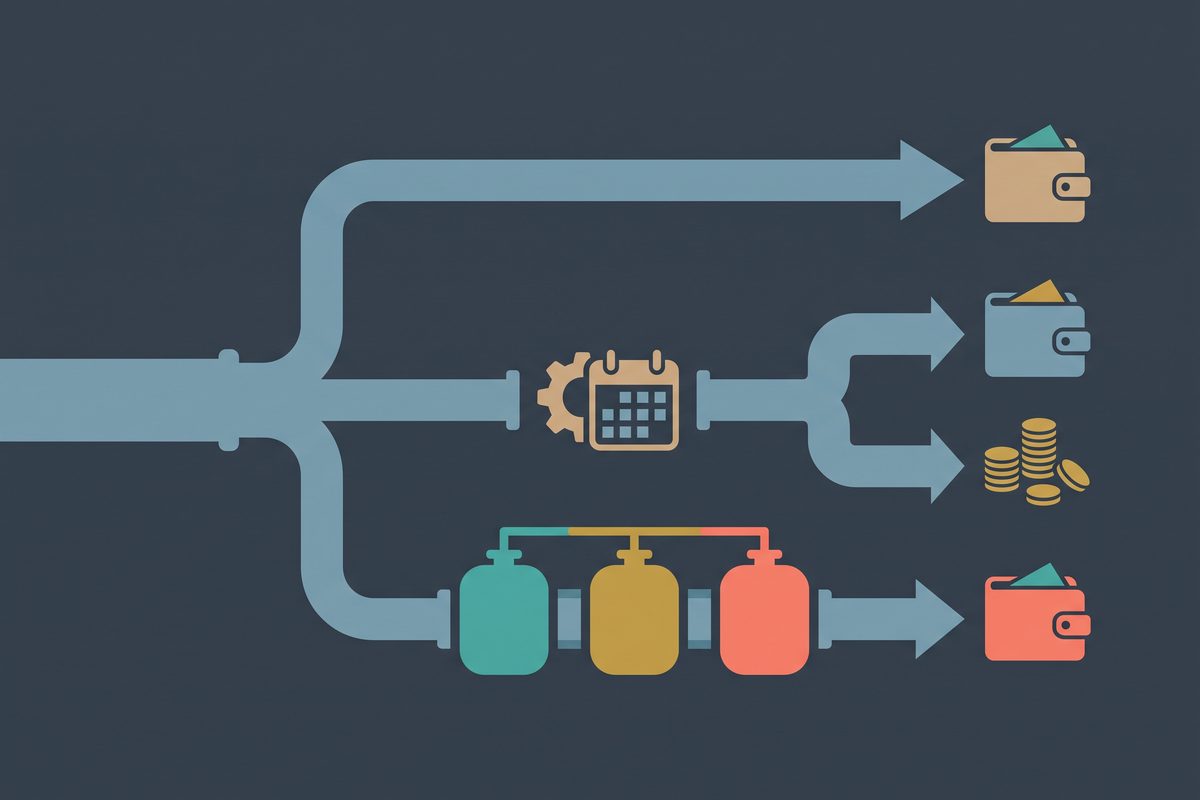
This is the method most solopreneurs actually need, because it handles the problem the first two ignore: income that arrives in lumps. Mike Michalowicz’s book Profit First popularized it. Every deposit is divided on a fixed schedule into separate accounts for taxes, operating costs and the owner, and you pay yourself the same amount each period from the owner account whether the month was good or bad.

Its tax consequence is zero. A sole proprietor still owes tax on Schedule C profit. An S corp owner still needs a reasonable wage. The split rides on top of whichever method your structure gives you.
I worked in finance before I started running online businesses on my own, and one habit survived the move: every payout gets booked at its gross amount on the day it lands, before any of it is split. Platform payouts arrive net of fees, on each platform’s own calendar, in amounts that swing from month to month. Split the net deposit and the fees vanish from your records, and the percentages get applied to the wrong number. Book the gross, record the fee, then split.
Size the tax account from the IRS safe harbor rather than a rule of thumb. You generally avoid the underpayment penalty if your payments cover 90% of this year’s tax or 100% of last year’s, whichever is smaller. The 100% becomes 110% if your 2025 adjusted gross income was over $150,000 ($75,000 if married filing separately). The 2026 installments are due April 15, June 15 and September 15, 2026, and January 15, 2027. The worksheet is walked through step by step in quarterly estimated taxes for creators.
How much to pay yourself
The IRS sets no pay figure for a sole proprietor, and the percentages that circulate online are someone else’s business model. Work it out in this order instead.
- Fund the tax account first, sized from the safe harbor above.
- Keep an operating float next, enough for the business’s fixed bills over the next two months.
- Pay yourself from what’s left, as a flat amount you could have covered in your slowest recent month.
If that flat amount doesn’t cover your household budget, you have learned something about the business, not about the payment method. No structure fixes a business that doesn’t yet earn enough to pay its owner.
For an S corp owner the order is the same with one change. The reasonable wage is the floor, and distributions come out of what remains after it.
Six mistakes that cost the most
Run this checklist once a quarter. Each item points to the IRS page behind it.
- Commingling. Paying yourself out of a mixed account means rebuilding the business year from memory. Publication 583 says to open a business checking account as one of the first steps, and the burden of proof for everything on your return is yours. The setup is covered in business bank account for a sole proprietor.
- No tax set-aside. A draw has no withholding, so the tax account is the only withholding you have. Skipping it turns a quarterly payment into an April bill with a possible penalty.
- Payroll in a default LLC. Running yourself through payroll without an S election does not create a deductible wage.
- A token S corp wage. A salary that ignores where the receipts come from invites reclassification of distributions as wages.
- A missed election window. Form 2553 has a filing window tied to the year you want it to cover. Put the date on your calendar the day you decide.
- Distributions with no estimates. Paycheck withholding does not cover the profit you took as distributions.
What to do this week
Write one line and keep it where you do your books: your method, your split day, and your three percentages. Then schedule a recurring transfer of the same flat amount from the owner account to your personal account on the same day each period, and let the first one run before you change anything.
Frequently asked questions
Is an owner's draw taxable?
Not as a separate item. A sole proprietor or single-member LLC owner is taxed on the business's net profit on Schedule C, whether that money is withdrawn or left in the account. The draw only moves profit that is already counted, and the Schedule C instructions say amounts paid to yourself do not belong on the wages line.
Can a single-member LLC owner pay themselves a W-2 salary?
Not as a deductible wage unless the LLC elects to be taxed as a corporation, which for most solo owners means an S corporation election on Form 2553. By default the IRS disregards a one-member LLC for income tax and applies self-employment tax to the owner the same way it does for a sole proprietor.
How much salary should an S corp owner pay themselves?
Enough to count as reasonable compensation for the work performed. The IRS looks at where the company's gross receipts come from and at factors such as duties, time devoted to the business, and what comparable businesses pay for similar services. When the owner's own work produces nearly all the revenue, the wage has to reflect that.
Do S corp owners still make estimated tax payments?
Often, yes. Payroll withholding covers the wage, but the IRS lists S corporation shareholders among the people who must pay estimated tax if they expect to owe $1,000 or more when they file. That usually comes from the profit taken as distributions.
Does the Profit First method lower my taxes?
No. A percentage split is a cash routine, not a tax structure. Taxes still follow your entity: Schedule C profit for a sole proprietor, wage plus pass-through profit for an S corporation. What the split does is make sure the tax money is sitting there when a quarterly payment comes due.
Sources
- IRS: Paying yourself
- IRS: S corporation compensation and medical insurance issues
- IRS: Single member limited liability companies
- IRS: Instructions for Schedule C (Form 1040), 2025
- IRS: Self-employment tax (Social Security and Medicare taxes)
- SSA: 2026 Social Security changes fact sheet
- IRS: Estimated taxes
- IRS: Form 1040-ES, Estimated Tax for Individuals, 2026 (PDF)
- IRS: Instructions for Form 2553
- IRS Publication 583: Starting a Business and Keeping Records
- IRS: Recordkeeping
This article is general information based on the author's experience. It is not licensed financial, legal, or tax advice. See the editorial policy.