Quarterly Estimated Taxes for YouTubers: The 2026 Numbers
Who owes quarterly estimated taxes on YouTube income, the 2026 due dates and safe-harbor rules, and a worked 1040-ES example with this year's numbers.

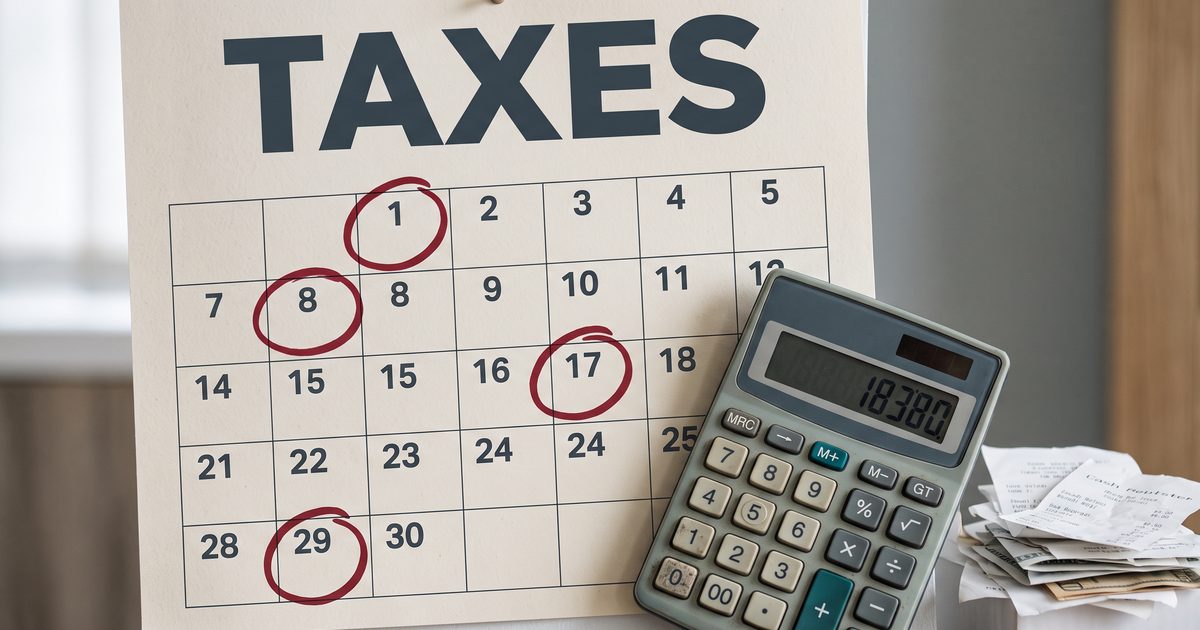
Your channel got monetized, AdSense started paying out, and nobody withheld a cent — which means the IRS expects you to send money yourself, four times a year. This article covers who actually has to pay quarterly estimated taxes on creator income, the 2026 due dates, and the safe-harbor rule that makes penalties impossible to trigger. Then it walks one hypothetical creator through the real Form 1040-ES math so you can see where your own number comes from.
This is general information, not tax advice, and Paschal is not licensed to give tax advice. For the rules straight from the source, start with the IRS estimated taxes page and the 2026 Form 1040-ES; for your specific situation, talk to a tax professional.
Why nobody withheld anything
A W-2 employer sends part of every paycheck to the IRS before you ever see it. Platforms don’t. An AdSense payout, a sponsorship wire, an affiliate deposit — each lands in your bank account whole, and the tax on it is still owed.
I’ve collected AdSense payouts for years, and the rhythm is deceptive. AdSense pays monthly once you cross its $100 threshold, so the money feels like a salary. It isn’t. Before going independent I worked in finance, where pay-as-you-go withholding is the water everyone swims in, and even people with that background get caught out the first year no one withholds for them. The system underneath is simple: US tax is pay-as-you-go, and when no employer pays as you go, you do.
Two taxes ride on creator profit. Income tax is the one everyone knows. Self-employment tax is the one that surprises people: 15.3% of net self-employment earnings, covering both the worker and employer halves of Social Security (a 12.4% piece) and Medicare (a 2.9% piece) that a job would otherwise split with you. Once your net earnings from self-employment reach $400 for the year, you file and pay it.
Who actually has to pay quarterly
The trigger is a single test. You must make estimated payments for 2026 if you expect to owe at least $1,000 after subtracting withholding and refundable credits — and your withholding won’t reach the safe-harbor floor described below.
That bar is lower than it sounds. At the 15.3% self-employment rate alone, about $7,100 of annual net profit already produces more than $1,000 of tax. A channel covering its costs plus a few hundred dollars a month is in quarterly territory. This is not “big YouTuber” money.
The day-job exception matters, though. If you also earn a W-2 salary, the withholding from that paycheck counts toward your total, and it counts as if paid evenly through the year no matter when it happens. Plenty of side-gig creators skip estimated payments entirely by filing a new W-4 and having their employer withhold more — a clean fix even in November.
The 2026 due dates and the safe-harbor rule
The IRS calls them quarterly payments. Look at the periods: they are not quarters.
The 2026 estimated tax calendar, from Form 1040-ES, collected from IRS.gov on August 31, 2026:
| Payment | Due date | Income period covered | Months in period |
|---|---|---|---|
| 1 | April 15, 2026 | Jan 1 – Mar 31 | 3 |
| 2 | June 15, 2026 | Apr 1 – May 31 | 2 |
| 3 | September 15, 2026 | Jun 1 – Aug 31 | 3 |
| 4 | January 15, 2027 | Sep 1 – Dec 31 | 4 |
The June date is the trap. Payment 2 arrives only two months after payment 1, and creators on a monthly payout cycle routinely get caught short there. The fourth period runs four months, so the January payment covers a third of the year’s income.
The safe harbor is the part worth memorizing. You will not owe an underpayment penalty for 2026 if your payments plus withholding reach the smaller of two floors. Floor one: 90% of the tax that ends up on your 2026 return. Floor two: 100% of the tax shown on your 2025 return — or 110% if your 2025 adjusted gross income topped $150,000 ($75,000 married filing separately).
Read that second line again if this is your first good year. Pay 100% of last year’s small tax bill, spread over the four dates, and you are protected completely — even if 2026 income triples. You’ll still owe the balance next April, but with zero penalty. Park the difference in savings and let it sit.
What income you’re estimating
Everything the channel earns counts, whether or not any form reports it. The IRS states plainly that all income must be reported regardless of whether a 1099 arrives. Forms are paperwork thresholds, not taxability thresholds — and both thresholds changed for 2026.
Creator income streams and their 2026 paperwork, from IRS instructions and AdSense documentation, collected August 31, 2026:
| Income stream | Form you might get for 2026 | Counts toward your estimate? |
|---|---|---|
| AdSense / platform ad payouts | 1099 from Google if over the reporting threshold | Yes, always |
| Sponsorships and brand deals | 1099-NEC at $2,000+ per payer | Yes, always |
| Affiliate commissions | 1099-NEC or 1099-MISC at $2,000+ per payer | Yes, always |
| Memberships, Super Chat, tips | Included in platform payout reporting | Yes, always |
| Digital products via processors | 1099-K over $20,000 and 200 transactions | Yes, always |
The 1099-NEC threshold moved from $600 to $2,000 for tax years after 2025 under Public Law 119-21, with inflation adjustments starting in 2027. The 1099-K threshold reverted to more than $20,000 across more than 200 transactions. Practical effect: in 2026 you will receive fewer forms than an older guide predicts, while owing exactly the same tax. Your bookkeeping is the record.
Count payments when you receive them. A cash-basis creator estimating for the June 15 date adds up what actually hit the bank in April and May — not what the YouTube dashboard accrued. If display ads are part of your revenue mix, payout timing differs by network; the payout mechanics in AdSense vs Mediavine vs Raptive show why the deposit date and the earning month rarely match. Selling an ebook or template on the side? Those receipts go in the same pile — more on that stream in selling an ebook without ads.
The math, start to finish

Here is one hypothetical creator — the numbers are invented for illustration — walked through the actual 2026 Form 1040-ES worksheet. Every rate and threshold below comes from the 2026 form and the IRS 2026 inflation adjustments. She is single, takes the standard deduction, and the channel is her only income.
Her estimate: $12,000 per quarter in payouts and sponsorships, about $2,000 per quarter in expenses (editor, gear, software). Expected net profit for 2026: $40,000.
Step 1 — Net earnings from self-employment. The worksheet multiplies net profit by 92.35%: $40,000 × 0.9235 = $36,940.
Step 2 — Self-employment tax. $36,940 sits far below the $184,500 Social Security wage base for 2026, so the full 15.3% applies: $36,940 × 0.153 = $5,652 (rounded).
Step 3 — Deduct half of it. One half of self-employment tax is deductible: $2,826. Her adjusted gross income becomes $40,000 − $2,826 = $37,174.
Step 4 — Standard deduction. The 2026 standard deduction for a single filer is $16,100. Taxable income: $37,174 − $16,100 = $21,074.
Step 5 — Income tax with 2026 brackets. For single filers, 10% applies up to $12,400 and 12% above that: $1,240 + 12% × ($21,074 − $12,400) = $1,240 + $1,041 = $2,281.
Step 6 — Total and divide. $5,652 + $2,281 = $7,933 expected federal tax. Divided by four: about $1,983 per due date.
That’s roughly 20% of her net profit, which is why the common set-aside guidance of 20–30% of profit holds up for moderate incomes — the top of the range buys room for state income tax and bracket creep. The 1040-ES worksheet also carries a line for the qualified business income deduction, which lowers the income-tax piece for eligible filers; the example leaves it out, which keeps the estimate conservative rather than optimistic. Past $200,000 of income for a single filer an extra 0.9% Medicare tax kicks in, and at that level an S-corp conversation usually starts too — different article.
If you’d rather use the safe-harbor version: take the total tax shown on her 2025 return, divide it by four, schedule it. Done.
If your income is lumpy
Creator income spikes. A video goes viral in October, a brand deal lands in December, and the even-quarters assumption breaks.
Two tools handle it. The blunt one is the prior-year safe harbor above: pay 100% (or 110%) of last year’s tax in four equal installments and ignore the spikes until April.
The precise one is the annualized income installment method, filed on Form 2210, Schedule AI. It recalculates each installment from what you had actually earned by the end of each period, so a creator who made most of her money in the fall isn’t penalized for paying small amounts in spring. It demands real bookkeeping. If your income is genuinely seasonal, it earns its keep — or a tax pro’s fee does.
Miss a date entirely? The penalty is computed from the amount of the underpayment, the time it stayed unpaid, and the IRS’s quarterly underpayment interest rate. It behaves like interest, not like a fine with a court date attached. Pay when you notice, adjust the rest, move on.
How to pay: Direct Pay vs EFTPS
Both official channels are free. They differ in setup and scheduling:
| IRS Direct Pay | EFTPS | |
|---|---|---|
| Enrollment | None | Required; processing up to 5 business days |
| Scheduling | Yes; change or cancel up to 2 days before | Up to 365 days ahead |
| Best for | Paying one date at a time | Scheduling all four dates in one sitting |
Direct Pay pulls straight from your bank account with no account creation and handles estimated tax payments directly. EFTPS is the Treasury’s older workhorse: enroll once, then schedule the entire year in advance. Mailing a check with a 1040-ES voucher still works, but with two free electronic options there is little reason to trust a postmark.
State tax is a separate lane. If your state has an income tax, it likely runs its own estimated payment schedule through its own portal — check your state revenue department before assuming the federal payments cover you.
Set it up once
The 10-minute setup checklist — one sitting, then the system runs itself:
- Pick your payment rail. No patience for enrollment: bookmark Direct Pay. Want the year scheduled in one go: start EFTPS enrollment today, since processing can take five business days.
- Create four calendar events. I run my whole operation out of Google Calendar, and the four tax dates sit there as all-day events with reminders a week ahead. The June event carries an extra note that it lands only two months after April — that’s the one that sneaks up on almost everyone. Copy the table above into yours.
- Open a separate savings account for tax money. Each payout that lands, move your percentage — 20–30% of net profit per the worked example — before the money starts looking spendable.
- Write down last year’s total tax. That one number, divided by four, is your penalty-proof floor under the safe harbor. Tape it to the monitor if you have to.
The whole system is four dates, one percentage, and one worksheet. Today’s move: put the four 2026 dates in your calendar and start your EFTPS enrollment (or bookmark Direct Pay), so the next payout that arrives gets its slice set aside instead of spent.
Frequently asked questions
Do I owe quarterly taxes if YouTube is a side gig next to a W-2 job?
Maybe not. The trigger is expecting to owe $1,000 or more beyond what your job withholds. Many side-gig creators skip estimated payments by raising withholding on their W-2 paycheck instead, since withholding counts no matter when in the year it happens. Run the 1040-ES worksheet once to check.
What happens if I miss a quarterly payment?
The IRS charges an underpayment penalty that works like interest: it depends on how much you underpaid and for how long, at the IRS's quarterly underpayment rate. It is not a criminal matter and there is no separate late form. Pay as soon as you notice, then adjust the remaining payments.
How much should a YouTuber set aside for taxes?
A common range is 20 to 30 percent of net profit for federal tax, before state tax. In the worked example in this article, a creator with $40,000 of 2026 net profit owes about 20 percent. Higher profit pushes you into higher brackets, so re-run the math when income jumps.
Do I still owe taxes if I never got a 1099?
Yes. All income is taxable whether or not a form arrives, and the IRS says so explicitly. The 2026 form thresholds only control paperwork: 1099-NEC now starts at $2,000 per payer and 1099-K at $20,000 with 200 transactions. Your books, not the forms, are the record that matters.
Are the four payments equal amounts?
Only if you use the default method of dividing the annual estimate by four. The periods themselves are unequal — two, two, three, and four months. If your income is lumpy, the annualized income installment method on Form 2210 Schedule AI lets each payment track what you actually earned.
Sources
- IRS: Form 1040-ES, Estimated Tax for Individuals (2026)
- IRS: Estimated taxes (Businesses & Self-Employed)
- IRS: Self-employment tax (Social Security and Medicare taxes)
- IRS: Tax inflation adjustments for tax year 2026
- IRS: Underpayment of estimated tax by individuals penalty
- IRS: Pay taxes from your bank account with Direct Pay
- IRS: EFTPS — The Electronic Federal Tax Payment System
- IRS: Instructions for Forms 1099-MISC and 1099-NEC
- IRS: Understanding your Form 1099-K
- IRS: The One, Big, Beautiful Bill — what gig economy workers should know
- Google AdSense Help: Payment thresholds
This article is general information based on the author's experience. It is not licensed financial, legal, or tax advice. See the editorial policy.